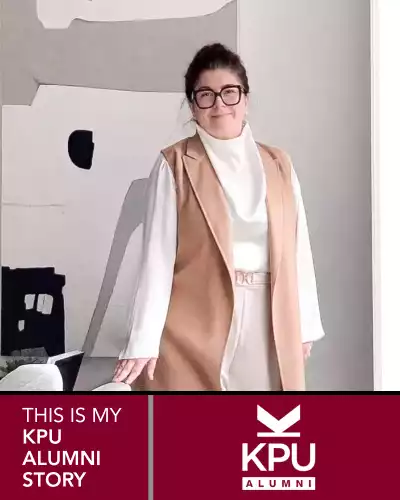
SLADJANA BOROVCANIN (she/her)
Née DobricInterior Design - 2004
What brought you to KPU and your program of study?
What brought me to KPU was a deep interest in interior design, but more importantly, a belief that interior design has the power to shape how people learn, work, gather, and belong. I was drawn to the field because it connected creativity with purpose, not simply creating beautiful spaces, but understanding how the built environment can influence people, communities, and institutions.
During my time at KPU, I had the opportunity to participate in a student exchange program and study interior architecture at the Universidad de Guadalajara in Mexico. That experience expanded my worldview, strengthened friendships I continue to nurture today, and helped me understand the importance of cultural exchange, curiosity, and connection. Through relationships formed at KPU, I also learned about a non-profit community organization that supported international studies. Pursuing that opportunity led to a scholarship and eventually to completing my master’s degree in design & environment in London, UK.
Looking back, KPU was not only where I studied. It was where I began building the confidence, relationships, and sense of purpose that shaped my career.
Can you briefly describe your current position and your main day to day responsibilities?
Most recently, I served as Director of Facilities Management at Vancouver Community College, where I provided strategic leadership across facilities operations, space planning, capital projects, infrastructure renewal, sustainability, and campus planning in a complex multi-campus post-secondary environment.
My day-to-day responsibilities involved aligning physical infrastructure with academic priorities and long-term institutional goals. That included overseeing space allocation and utilization, capital and operating budgets, campus renewal projects, procurement, consultant and contractor management, accessibility, sustainability, and facilities operations. I worked closely with executive leadership, academic departments, government partners, unions, consultants, and operational teams to ensure campuses remained functional, safe, inclusive, and responsive to the needs of students, employees, and the broader community.
Earlier in my career, I returned to KPU as a faculty member in the Interior Design program, and as an employee in Facilities Management department, where I helped establish and grow in-house space planning and interior design capacity. That work allowed me to contribute directly to campus growth, infrastructure and space planning, reuse of existing assets, campus renewals, and early development work connected to the Wilson School of Design.
Which skills, knowledge, or experiences from KPU have been most valuable in your career so far?
The most valuable experiences I gained at KPU were not limited to technical design skills, although those were foundational. KPU taught me the importance of business communication, applied learning, collaboration, and connecting ideas to real-world outcomes.
Through studio work, field studies, student exchange, and faculty mentorship, I learned how to communicate ideas clearly, listen to different perspectives, advocate for design decisions, and understand the practical realities behind implementation. Those skills became essential as my career grew into entrepreneurship, infrastructure and capital planning, operations, governance, and executive leadership.
KPU also showed me the importance of intentional exposure - saying yes to field study, international exchange, industry connections, volunteer opportunities, and relationships that may not have an immediate outcome but can shape your path in powerful ways. My education gave me a design foundation, but the broader KPU experience taught me how to build trust, navigate complexity, and contribute meaningfully to organizations and communities.
What advice would you give current KPU students who want to build a successful career after graduation?
My advice would be: build your network slowly, intentionally, and with purpose. It all starts with connection.
Careers rarely unfold in a straight line. Mine has moved through interior design, teaching, facilities planning, entrepreneurship, major public sector and post-secondary leadership, sustainability, and community governance. Each step was shaped by relationships, curiosity, hard work, and a willingness to remain open to opportunities that did not always look obvious at the beginning.
Take your education seriously but also take your relationships seriously. Stay connected to your faculty, peers, mentors, community organizations, and professional networks. Be generous with what you know, and do not underestimate the value of giving back. Some of the most meaningful opportunities in my life came through people who believed in me, opened a door, or shared a connection - and I have tried to do the same for others.
Success is not only about advancing your own career. It is also about using your skills to create impact, support others, and contribute to something larger than yourself. Whether through your profession, your community, or Board leadership (very dear to my heart), find the places where your work can make a difference. That is where a career becomes truly meaningful and your contributions invaluable.