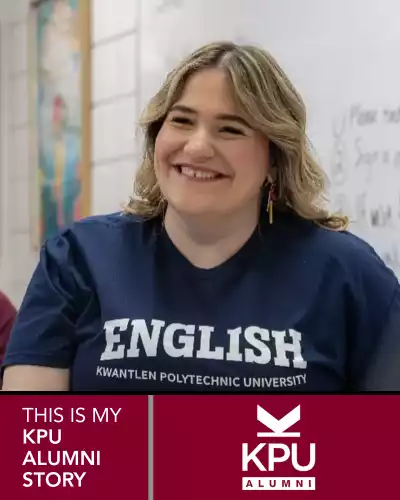
MONTANA FINN (She/Her)
English - 2025
What brought you to KPU and your program of study?
I originally came to KPU in 2018 to study in the Faculty of Health. KPU felt like a natural choice because it was close to my high school, and many students from my school continued their education there after graduation. However, after some time in the program, I realized that the health field was not the right fit for me, and I needed to rethink the direction I wanted to take.
After taking some time away from school and eventually returning to KPU, I found my place in the English department. I have always loved literature and enjoyed discussing books, ideas, and different perspectives, so being in a department where those conversations are encouraged every day felt incredibly rewarding. Studying English allowed me to connect my passion for reading and writing with my academic goals, and it helped me rediscover my confidence and excitement for learning.
My time in the English program also helped me realize that I wanted to become a teacher. I am now going into English education, where I hope to share my passion for literature and learning with future students. Looking back, my journey to finding the right program was not straightforward, but it ultimately led me to a path that feels meaningful and rewarding.
Can you briefly describe your current position and your main day to day responsibilities?
I am currently completing my Bachelor of Education at the University of British Columbia, specializing in English and Social Studies education. Beginning this September, I will be starting a teaching position in Maple Ridge.
Throughout my practicum experience, I taught English Literature Studies 11, English 9, and Social Studies 9, where I gradually assumed the full responsibilities of a classroom teacher. My day-to-day responsibilities included planning and delivering lessons, creating unit plans, assessing and providing feedback on student work, and adapting instruction to support a variety of learning needs and abilities. I also facilitated classroom discussions, developed activities that encouraged critical thinking and collaboration, and worked to build positive relationships with students to create a supportive and engaging learning environment.
In English classes, I focused heavily on literature analysis, writing instruction, and helping students develop confidence in expressing their ideas both verbally and in writing. In Social Studies, I encouraged students to think critically about historical and contemporary issues while helping them make connections between course content and the world around them. Beyond instruction, I also participated in staff collaboration, classroom management, and school community activities, which gave me a deeper understanding of the many responsibilities teachers balance on a daily basis.
Which skills, knowledge, or experiences from KPU have been most valuable in your career so far?
One of the most valuable aspects of my experience at Kwantlen Polytechnic University was the opportunity to develop both academically and personally in ways that directly support my career in education. Through my English studies, I strengthened important skills such as critical thinking, close reading, academic writing, communication, and problem solving. These skills have been incredibly valuable in teaching, especially when helping students analyze texts, express their ideas clearly, and think critically about the world around them.
I also had opportunities to attend Anti-Racism Symposiums and engage in conversations surrounding equity, inclusion, and social responsibility. Those experiences encouraged me to become more reflective and introspective, both as a person and as an educator. They helped shape the way I approach teaching by reinforcing the importance of creating inclusive classroom spaces where students feel respected, represented, and supported.
Another aspect of KPU that had a major impact on me was the faculty and classroom environment. I connected with incredibly passionate professors who genuinely cared about teaching and sharing knowledge with students. Because of KPU’s smaller class sizes, I always felt seen and supported in the classroom, which allowed me to build meaningful, long-lasting relationships with faculty members. Having professors who were approachable and willing to provide guidance and mentorship gave me confidence in my academic abilities and encouraged me to pursue teaching as a career.
Overall, my experience at KPU helped me grow into a more thoughtful communicator, critical thinker, and future educator, while also showing me the importance of fostering strong relationships and inclusive learning environments within education
What advice would you give current KPU students who want to build a successful career after graduation?
My biggest piece of advice for current Kwantlen Polytechnic University students would be to stay open to change and not feel discouraged if your path looks different from what you originally expected. When I first came to KPU, I thought I had my future completely figured out, but over time I realized that my original program was not the right fit for me. Although changing directions felt difficult at the time, it ultimately led me to a field that I am genuinely passionate about. Your career path does not always have to be linear in order to be successful.
I would also encourage students to take advantage of the relationships and opportunities available at KPU. The smaller class sizes create a unique environment where you can genuinely connect with professors, ask questions, seek guidance, and build mentorship relationships that can have a lasting impact on both your academic and professional life. Some of the most valuable experiences I had at KPU came from conversations with faculty members who were passionate about teaching and invested in student success.
In addition, I think it is important to get involved in experiences that help you grow outside of the classroom. Attending events, participating in discussions, and engaging with different perspectives can help shape who you are professionally and personally. For me, opportunities such as Anti-Racism Symposiums helped me become more reflective and thoughtful about the kind of educator and person I want to be.
Finally, I would remind students that success after graduation is not only about grades or having everything figured out immediately. Building a successful career also comes from being adaptable, willing to learn, open to feedback, and passionate about the work that you do. The experiences and connections you build during university can often be just as important as the degree itself.